Why Your Headless CMS Needs an SEO Health Dashboard
A headless CMS gives editors flexibility, but SEO quality drifts without visibility. Here is why every Sanity Studio should include an SEO Health Dashboard.
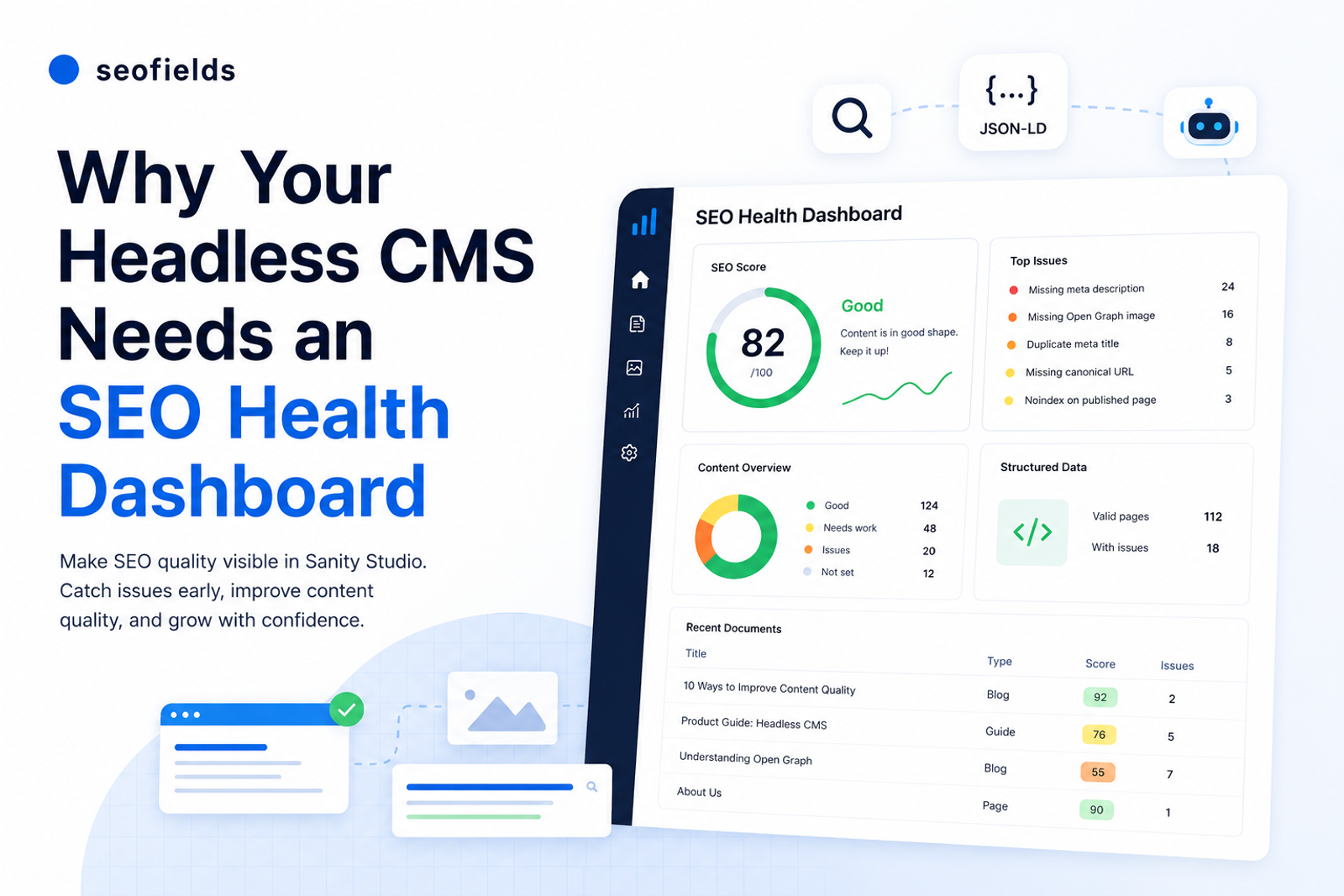
A headless CMS is great at separating content from presentation. That separation gives teams flexibility, but it also creates a quiet SEO problem: the people writing content often cannot see whether the page is ready for search, social previews, or AI answer surfaces.
An SEO Health Dashboard closes that gap. It turns invisible metadata work into a visible editorial workflow, so missing titles, weak descriptions, broken images, robots mistakes, and structured data gaps are caught before content ships.
SEO drifts when content lives in too many places
In a traditional CMS, SEO fields often sit close to templates and preview logic. In a headless setup, the content model, frontend rendering, metadata helpers, Open Graph image logic, and structured data output can all live in different parts of the stack.
That architecture is powerful, but it also means small mistakes compound. A document might have a strong headline but no meta description. A product page might have an Open Graph image in Sanity but no usable Twitter/X card image. A landing page might be publishable while accidentally set to noIndex.
What an SEO Health Dashboard should show
A useful dashboard is not just a list of empty fields. It should help editors, developers, and content leads understand where quality is strong, where it is fragile, and what to fix next.
- Meta title and description coverage, including length and duplication signals.
- Canonical URL and robots directive checks, especially for important published pages.
- Open Graph and Twitter/X card readiness for social sharing.
- Structured data coverage for pages that should be eligible for rich results or machine-readable context.
- Prioritized issue counts by document type, owner, or publishing workflow.
It turns SEO into editorial quality control
Most SEO failures are not developer failures. They happen during normal publishing: a page is rushed, a social image is skipped, a description is copied from another page, or a robots setting remains from a staging document. A dashboard makes these risks visible to the people closest to the content.
Good content operations do not rely on memory. They make quality visible at the moment decisions are made.
Why this belongs inside Sanity Studio
Sanity already owns the structured content. When SEO fields live there too, the dashboard should live there as well. Editors should not have to wait for a crawler, spreadsheet, or external audit to learn that a page is missing metadata. The feedback should be available while the document is still editable. For frontend rendering details, see the frontend integration docs.
AI search makes structured quality more important
Search is no longer only a list of blue links. AI Overviews, ChatGPT, Perplexity, and other answer engines reward content that is clear, complete, and machine-readable. Metadata alone will not guarantee visibility, but weak metadata and missing structured data make it harder for systems to understand a page.
This is where GEO and AEO readiness becomes practical. A dashboard can remind teams to add descriptive summaries, strong page titles, useful Open Graph text, and Schema.org data where it matters.
The score is not the goal. Better publishing is the goal.
A 0–100 SEO score is useful because it gives teams a shared language. But the number should not become theatre. The real value is in the issues behind the score: what is missing, how severe it is, and whether the fix is editorial, technical, or strategic.
Use the score as a routing system, not a vanity metric. It should help the team decide what to review before publish, what to batch-fix, and what needs schema or frontend work.
A healthy workflow is simple
- Model SEO fields directly in the CMS document types that publish to the web.
- Render metadata, social tags, robots directives, canonical URLs, and JSON-LD server-side in the frontend.
- Score documents inside Studio so editors can see what needs attention before publishing.
- Review low-scoring documents regularly and fix patterns at the schema or component level when possible.
The dashboard is a guardrail for growth
A headless CMS should not force teams to choose between flexible content architecture and reliable SEO operations. The right dashboard keeps both: developers keep clean frontend control, editors keep ownership of metadata, and content leads get a clear view of publishing quality across the whole studio.
That is why an SEO Health Dashboard is not just a nice extra. For a serious headless CMS setup, it is part of the publishing system.